
Knowledge management · AI memory
Project notes you and your AI work from.
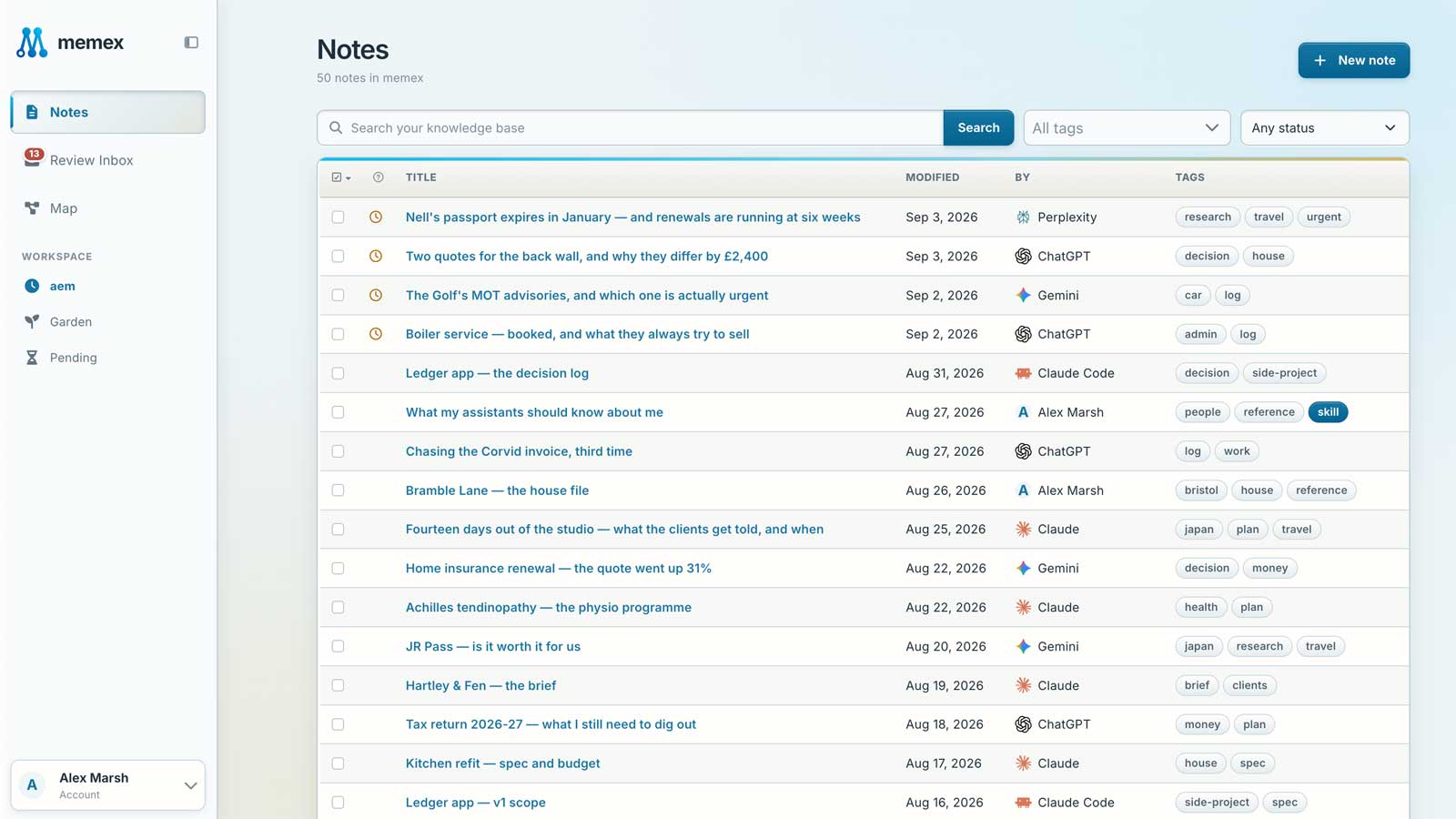
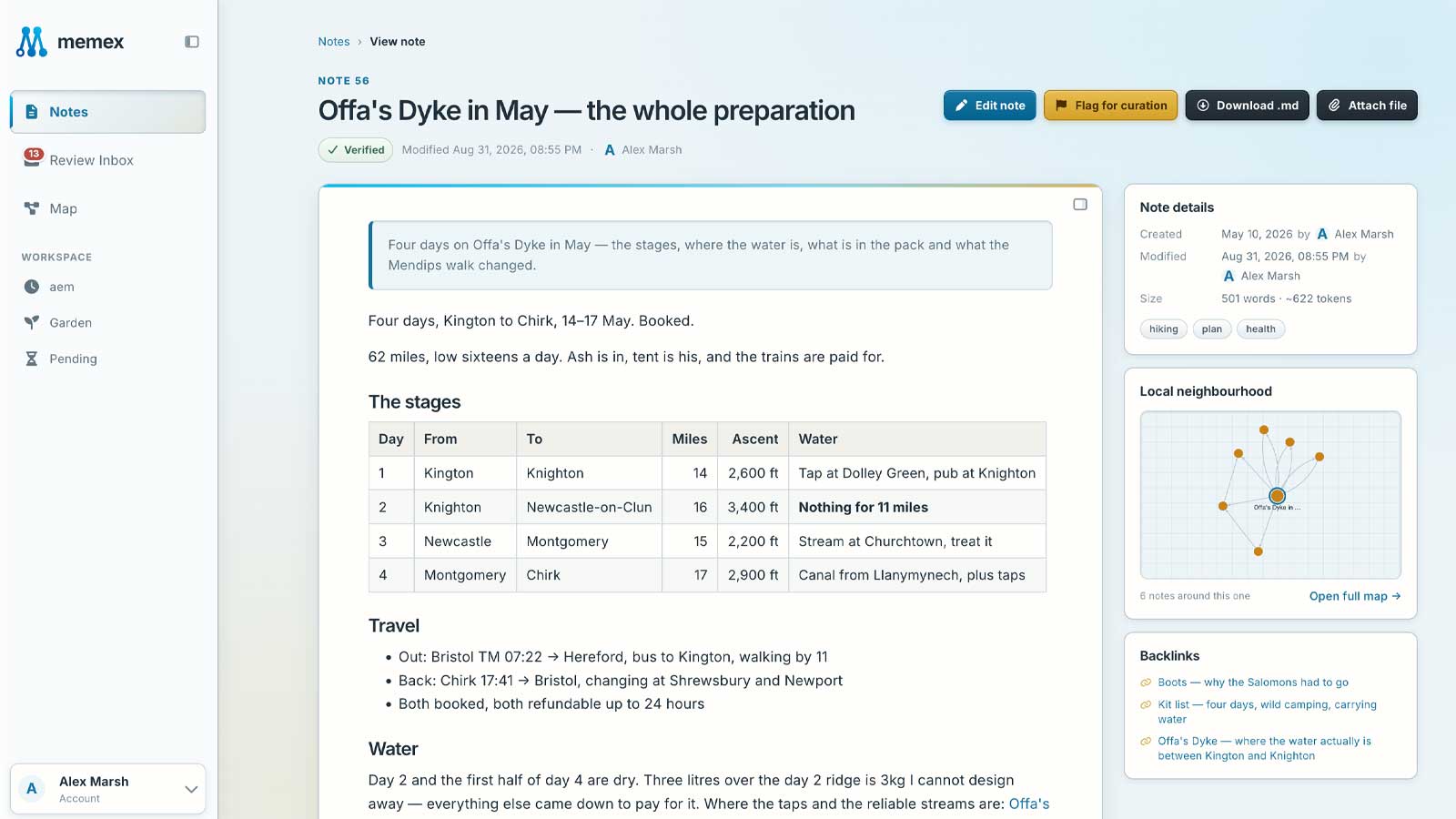
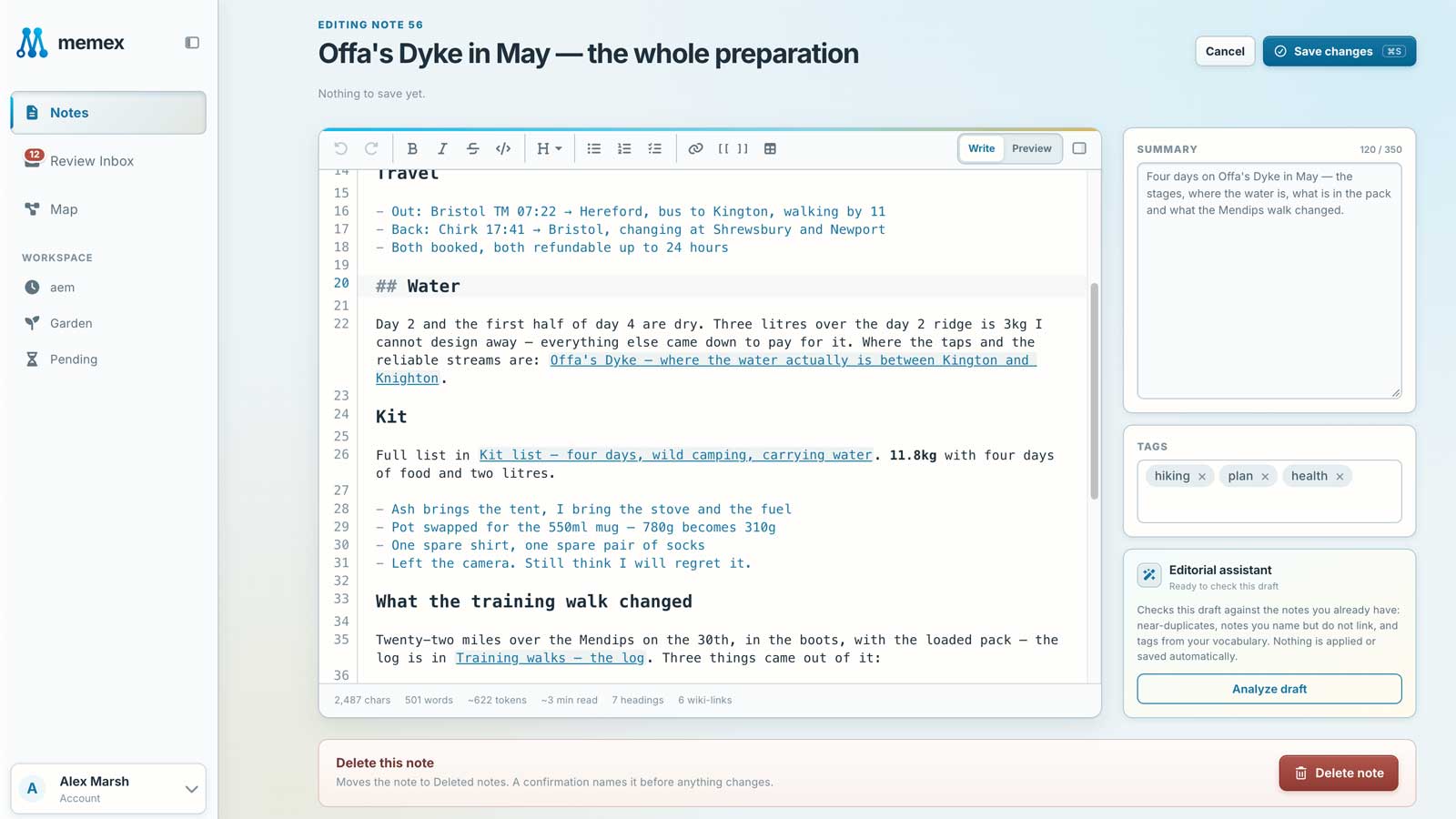
Memex is a web app where your AI can save decisions, reasoning and project context as notes. You can read and edit every note, then use it with any assistant you connect.
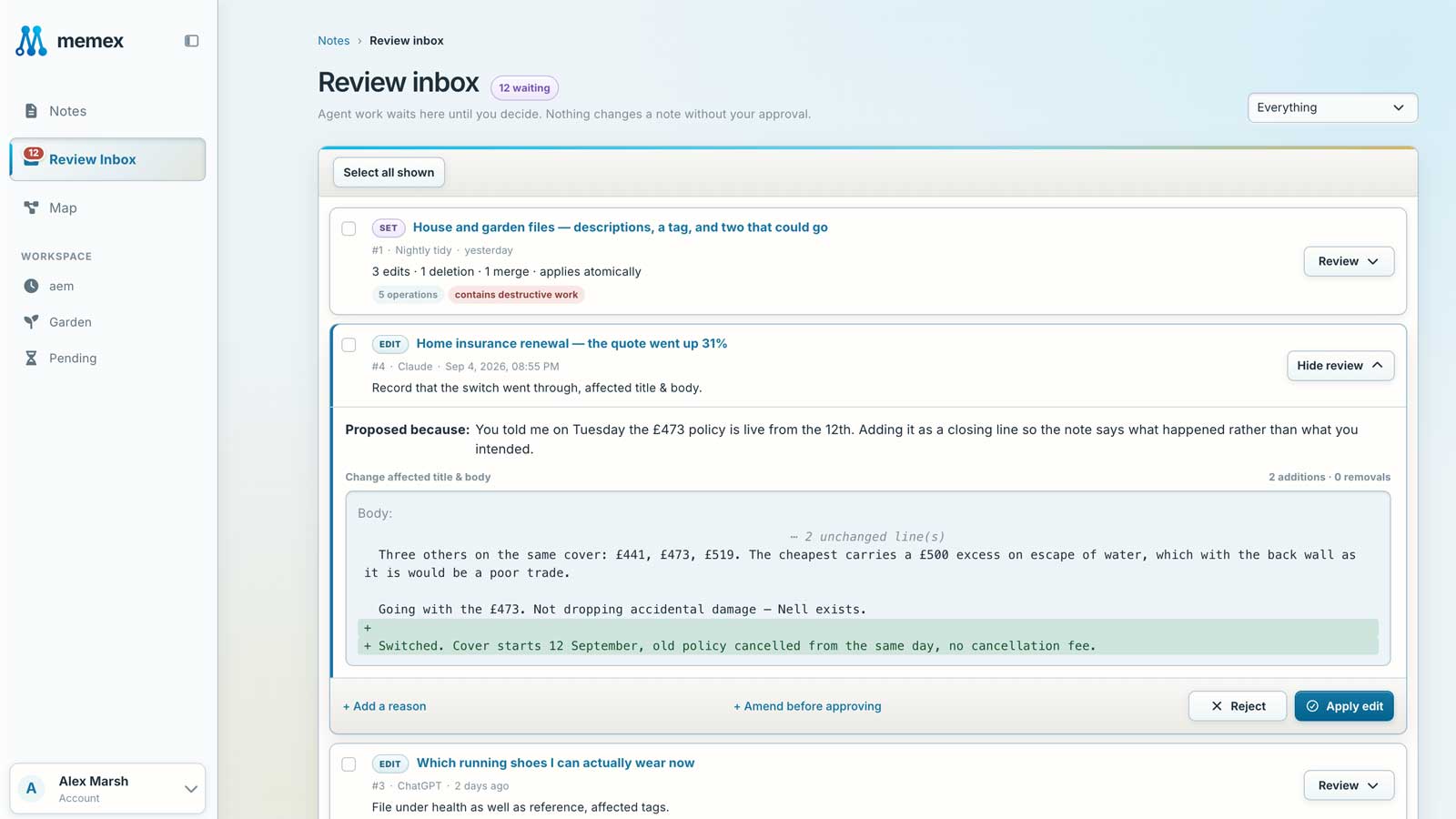
As your work changes, ask your assistant to update the notes. Review what it suggests and decide what stays.
Best with

How it works
Save a decision. Use it in the next conversation.
Ask your assistant to write up what you agreed, check the note, and use it when you continue the work.
Your connected assistant retrieves the note you saved.
Bring in everything into the next conversation yourself.
 ClaudeProject planning
 memex · propose · #219 · held for review
I’ve drafted an update to the website project note #219 with the launch scope, why we’re leaving booking for later, and the outstanding copy approval. It’s ready for you to review, proposal #1027 in your memex inbox.
 ChatGPTClient update draft
Read from memex · Client website
ChatGPTClient update draft
Read from memex · Client website
Found note #219 in memex. The first release will include the landing page and enquiry form. We’re leaving booking functionality for a later phase to keep the initial release small. We’re aiming for Friday, subject to your approval of the copy, but the delivery date isn’t confirmed yet.
ClaudeProject planning
I can write up the decisions, reasoning and open questions here, or create a file you can download.
Would you prefer the write-up in this chat, a Markdown file, or a Word document?
ChatGPTClient update draft
I don’t have the project note available here. Paste or upload it, and I’ll draft the update using the agreed scope, timing and outstanding decisions.
Turn useful conversations into working notes.
Work in your usual AI chat. Ask your assistant to read the relevant notes, save what you work out, and suggest updates when something changes. Open memex to review and edit the notes yourself.
-
Start with what you have.
Bring your existing notes, or start with the next thing you work out with AI.
-
Connect the assistants you use.
Decide what they can read and which changes need your approval.
-
Keep doing your thing.
Ask questions, explore ideas, work through the details. When something is worth keeping, say “save that to memex.”
-
Review what your assistant wrote.
Open the proposed note or update in memex. Read it, make any corrections, and decide what to keep.
-
Use the notes. Keep them current.
Next time, start with asking your assistant to read the relevant notes.
Nothing to install. Memex runs in your browser, and every one of these can start using it right away.
 ChatGPT
- Claude
 Gemini
 Perplexity
 Hermes
 OpenClaw
 Cursor
 Claude Code
 Codex
Codex MCP Standard
Every assistant you use today will be replaced by a better one tomorrow. What you worked out with them stays with you.
Compare memex
What memex adds to your AI workflow.
A chatbot lasts while you chat. A memory add-on remembers those chats. Memex builds you a knowledge base you can use with your AIs, or on your own.
| Regular chat | Custom memory* |  memex memex |
|
|---|---|---|---|
| What goes in | |||
| What is remembered | Regular chatWhatever the chat decides to keep in its own memory. | Custom memoryFacts or context extracted from conversations. | memexWhat you ask your assistant to write down: a summary, the findings, the background. |
| How that memory looks | Regular chatA summary or a certain detail about you and your work. | Custom memoryA database of facts extracted from transcripts. | memexA readable note, from a short answer to a detailed plan. |
| Ownership | Regular chatManage memory through the assistant’s settings. | Custom memoryAccess, editing and export through a dashboard or API. | memexYou decide what stays, edit the notes yourself, and export your work when needed. |
| Working from a document | Regular chatUploads remain available through chat history. | Custom memoryDocument content is indexed for extraction. | memexA note of the findings, saved by your assistant. The original file stays where it was. |
| Using past conversations | Regular chatThe chat’s own history and search. | Custom memorySearch stored memories or conversations. | memexSaved notes, holding what you and your AI chose to keep at the time. |
| Control and upkeep | |||
| When something is about to be saved | Regular chatMemory can be saved automatically or at your request. | Custom memorySaved on the spot under the product’s rules. You are not usually asked. | memexHeld for your approval in memex. Trusted permissions are available if you want them. |
| Correcting a mistake | Regular chatMemory controls may let you edit or wipe it. | Custom memoryDelete or edit stored memory facts. | memexOpen the note and change the sentence, or restore an earlier version. |
| Giving reusable instructions | Regular chatCustom instructions are usually supported. | Custom memorySaved preferences, configurations and rules. | memexEvery instruction and skill is a note you can open, edit or delete. |
| Tidying up | Regular chatMemory can update automatically or on request. | Custom memoryAutomatic updates or expiry. | memexMemex lists what needs attention; your own assistant works the list and files the changes for you to check. |
| Time spent reviewing | Regular chatNothing. Any routine review is optional. | Custom memoryOften little. Routine review is optional. | memexYou read and decide what is in memex. Proposed changes accumulate if you leave the inbox alone. |
| Access and organisation | |||
| Reading from another assistant | Regular chatGenerally within that provider’s own products. | Custom memoryAvailable across the clients and integrations the product supports. | memexAvailable across every client and integration that speaks MCP. |
| Getting connected | Regular chatJust open the chat. | Custom memoryA connector, an extension or a developer setup. Complexity varies. | memexA guided set-up of a few minutes in each assistant’s settings, permissions included. |
| Browsing what you have | Regular chatChat history and memory settings, projects. | Custom memoryA dashboard for stored records and source documents. | memexA web app: every note, its tags, its links, its history, and a map of the whole knowledge base. |
| Looking something up | Regular chatScroll back, or search through your chats. | Custom memoryKeyword and meaning search across everything stored. | memexSearch by meaning or by keyword, with filters on top. |
| A shared team space | Regular chatShared projects or workspaces on some plans. | Custom memorySome offer shared spaces. | memexNo. Each knowledge base belongs to one person. |
| Attachments | Regular chatUpload files to chats. | Custom memoryPDFs and other uploads are supported by some products. | memexText and Markdown imports, including a whole vault. A PDF becomes a note about it, written by your assistant when you ask. |
| Export and recovery | |||
| Downloading your material | Regular chatAccount or chat exports, in the provider’s format. | Custom memoryA bulk export in some cases; a selected list of facts in others. | memexEvery note as a Markdown file, or the whole knowledge base in one click. |
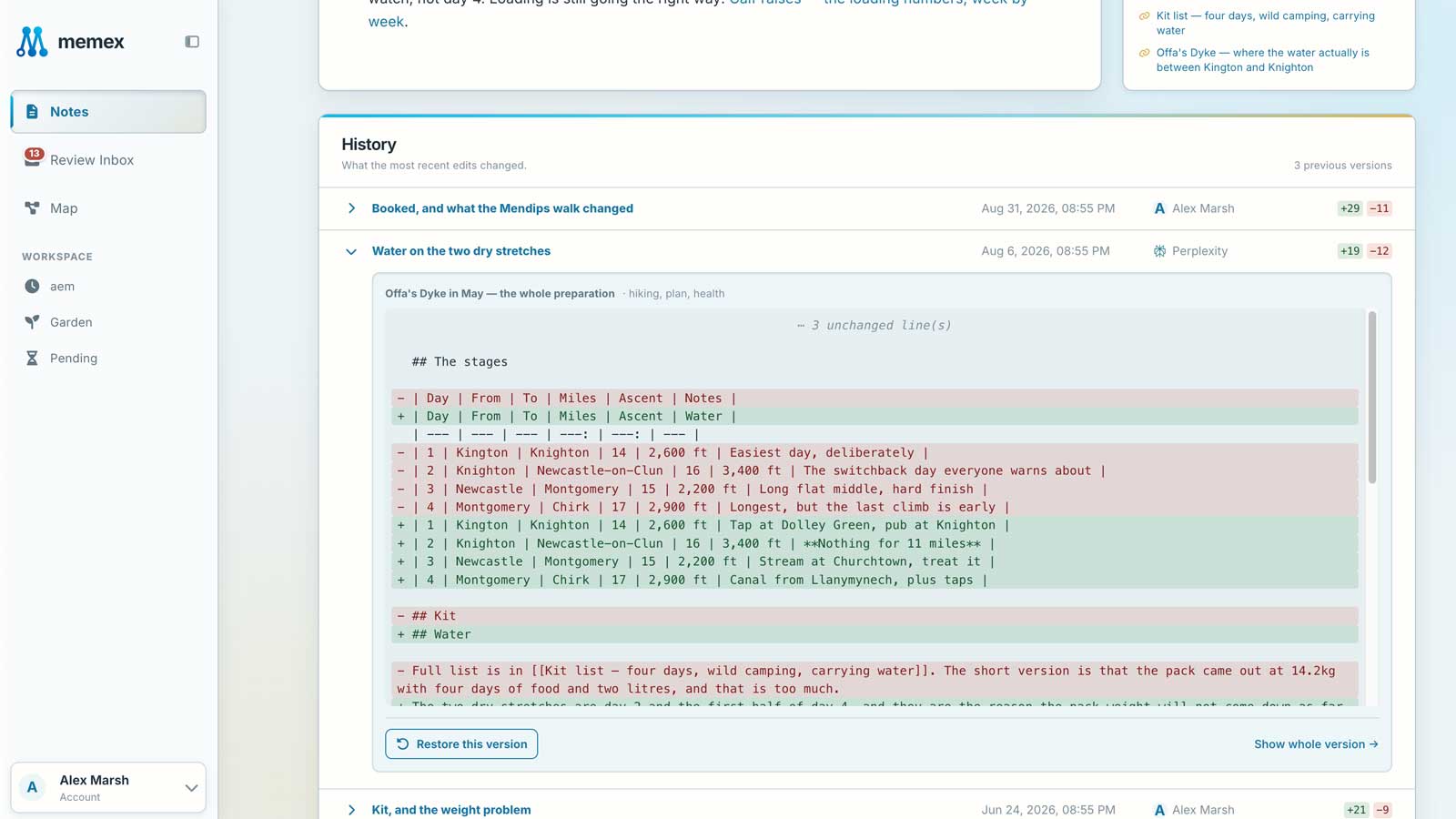
| Undoing an edit | Regular chatNot available. There is only what it says now. | Custom memoryHistory and rollback are supported by some products. | memexFull note history with authors and dates. Restore any earlier version. |
| Removing saved material | Regular chatYou can delete a chat; its memory may stay much longer. | Custom memoryDeletion controls under the product’s retention rules. | memexDeleted notes stay recoverable for thirty days before their content is purged. |
| Keeping a copy outside the service | Regular chatExport your chat history. | Custom memoryExport transcripts, facts or settings, depending on the provider. | memexMarkdown files you can open and use on your own machine, without memex. |
| Costs and conditions | |||
| What you pay for | Regular chatYour AI subscription. | Custom memoryFree and paid plans are offered. | memexMemex is free during early access. |
| Training on your data | Regular chatUsed for training unless you opt out. | Custom memoryThe product’s policy and its AI providers’ terms apply. | memexMemex does not train on your notes. Connected assistants have their own terms. |
* What is said here about AI providers and memory products comes from a review of more than sixty products as of September 2026. It describes patterns across the group, not a single product. They differ in scope, and the review did not test each claimed feature.
Memex is not a better memory plugin. It is a different approach. You can run a memory plugin alongside it: that one might remember how you prefer an answer, while memex holds the research note you approved. Both can be available to the same assistant.
Use what you already pay for. Use it better.
Guardrails and memex
Your AI proposes. You decide what stays.
AI can be wrong and sound exactly as certain as when it’s right. No better model fixes that; a person in the loop does. That person is you: read it, change what needs changing, approve.
Nothing lands without you.
Your memex inbox is where you decide. See what your assistants want to add or change, then approve or reject it. The library takes the shape you give it.
Every change is reversible.
Every edit is saved. Open a note’s history, see what changed, and restore any earlier version. A note you delete stays restorable for thirty days.
Plain files, just words.
Every memex note is a text file — the format anything can read, now and in twenty years.
Bring it in, take it out.
Bring in what you already have, take out everything you’ve built. One click in either direction.
Questions people actually ask
Who is memex for, and how much setup is involved?
People who use AI for ongoing work and want to maintain the notes their assistants work from. Those might be client briefs, research records or project plans. Memex suits people who want to review what their assistants write and keep those notes current.
You do not need to code. Allow a few minutes to follow the connection guide in your assistant’s settings, including its permissions. The requirements depend on the assistant and its plan. After that, ask your usual assistant to read or save notes while you work.
How does an assistant use a skill note?
A skill note tells an assistant how you want a particular repeating task done. You might write that a decision note must include the reasons and links to the evidence. Save that instruction as a note and tag it skill. Connected assistants can find it in memex, and you can ask them to use it for a particular task. You can edit or delete your skill notes at any time.
Doesn’t ChatGPT already remember things about me?
They all do, deep inside their own systems. Memex is one set of notes every assistant you connect can read, written in your words, with you deciding what goes in.
Why not just use Notion or Evernote?
Those are places you go to write. Memex is built around what your assistant writes and reads: it saves a note while you are talking to it, your other assistants read that note later, and you turn up to approve or reject what was saved. Every note names who wrote it, and by default nothing an assistant writes counts until you have said so. That inbox is the difference.
Will this make more work for me?
Only as much as you put in. Your assistant does the writing, and it is fine to let held notes sit until you have a minute.
A knowledge base does take the shape of the person who keeps it, though. Your part is the verdict: what is true, and what stays. Spend a minute on that per note and everything you build on it is better for it.
Who can see the information I save?
Notes are private to your account and stored on Amazon’s infrastructure in the US. Connected assistants can read them. Memex also sends note text to OpenAI for meaning-search indexing, so saving here can involve a provider you may not use for chat. Read the privacy policy before saving sensitive material, and keep passwords and API keys elsewhere.
Get yourself a memex.
Keep the work you build with AI as notes you control. Bring the context into any chat with a connected assistant, and pick up a project or a detail without explaining everything again.
Use memex online
We host it for you, keep it updated and back it up. Request an invitation to get started. We’re opening access in batches during Early Access.
We have your request.
We will be in touch when the next batch of invitations goes out.
Prefer to host it yourself?
An open-source version is coming. Run memex on your own infrastructure, manage your storage and backups, and connect your assistants to your own instance.